
Yara Simmons · 16 October 2026
Unlocking Efficiency Gains Through Adaptive User Permission Controls in Enterprise Software Environments
Adaptive user permission controls adjust access rights dynamically based on user roles, contextual factors such as location or device, and behavioral patterns within enterprise software platforms, and these systems reduce manual oversight while maintaining security boundaries during daily operations. Organizations deploy them to streamline workflows where static permissions often create bottlenecks that slow down project timelines and increase administrative workloads.
Core Components of Adaptive Systems
Researchers describe adaptive permission controls as relying on policy engines that evaluate real-time variables including authentication strength, network conditions, and task requirements before granting or revoking access, and this approach replaces rigid role-based models with layered decision trees that update continuously. Data from enterprise deployments shows that such engines cut permission-related support tickets by integrating machine learning models trained on historical access logs, which allows the system to predict and pre-approve routine actions without human intervention each time.
Implementation typically involves mapping organizational hierarchies to permission templates that evolve according to project phases or compliance deadlines, while audit trails capture every adjustment for later review by compliance teams. In October 2026 several platform providers plan to release updated toolkits that incorporate federated identity signals from multiple cloud providers, enabling smoother transitions when employees switch between on-premise and remote environments.
Efficiency Metrics Reported Across Industries
Studies compiled by the National Institute of Standards and Technology indicate that companies adopting adaptive controls experience measurable reductions in time spent on access management tasks, with average savings reaching 18 hours per administrator per month once the initial configuration stabilizes. These figures come from longitudinal tracking of IT departments that transitioned from static lists to context-aware rules, and the data further reveals faster onboarding cycles because new hires receive baseline access automatically adjusted by their department and location data.
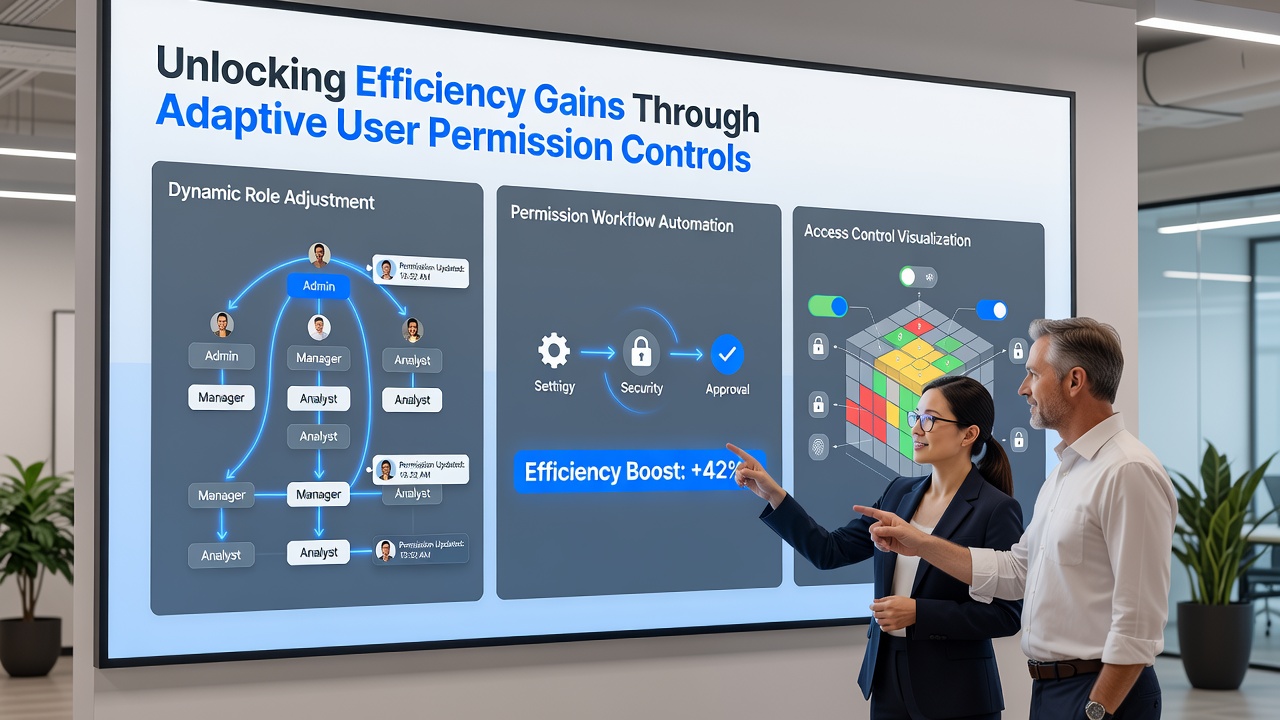
Productivity gains appear in cross-functional teams where permissions shift automatically when a user joins a temporary task force, eliminating the delays associated with submitting and approving separate requests. Observers note that this fluidity supports larger-scale operations without proportional growth in security staff, because the system handles routine variations while escalating only anomalous patterns for manual review.
Integration Patterns With Existing Infrastructure
Enterprise platforms combine adaptive controls with existing single sign-on services and directory services, allowing permission changes to propagate across connected applications without separate configuration in each tool, and this centralization reduces configuration drift that previously led to inconsistent access states. Technical documentation from deployments shows that API endpoints expose permission states to monitoring dashboards, giving managers visibility into usage trends that inform future policy refinements.
Canadian government guidelines on digital identity management highlight successful pilots where adaptive controls aligned with zero-trust architectures, resulting in fewer access revocations required after employee role changes because the system already adjusted based on updated employment records. Similar patterns emerge in European research consortia examining multi-tenant environments, where shared resources demand granular controls that adapt to tenant-specific compliance rules without manual overrides.
Challenges During Rollout Phases
Initial setup requires detailed mapping of business processes to permission triggers, and organizations that underinvest in this phase encounter temporary productivity dips until the models reach sufficient accuracy. Training datasets drawn from six to twelve months of prior logs help calibrate the system, yet incomplete logs from legacy applications can introduce gaps that delay full activation.
Testing protocols involve simulated scenarios where permissions adjust under varying conditions, allowing teams to verify that legitimate workflows remain uninterrupted while unauthorized attempts trigger appropriate responses. Post-deployment reviews track metrics such as false positive rates on access denials, and adjustments continue for several quarters before the system stabilizes at optimal efficiency levels.
Conclusion
Adaptive user permission controls deliver efficiency gains by automating access decisions that previously demanded constant human oversight, and the resulting time savings compound across large user bases when integrated with established enterprise platforms. Data collected through structured pilots and ongoing monitoring supports continued refinement of these systems, while October 2026 updates promise further alignment with evolving identity standards across regions. Organizations tracking adoption metrics report sustained improvements in operational throughput once the adaptive layers mature within their specific environments.